Boiled eggs change dramatically minute by minute. Compare yolk textures and discover the ideal timing for your preferred dish.
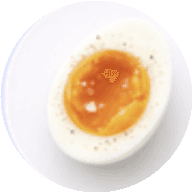
Yolk: Rich, runny, and glossy golden. Pours when pierced.
White: Tender, soft-set, and spoon-friendly without rubberiness.
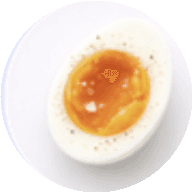
Yolk: Gooey, custard-like texture with translucent amber core.
White: Fully set, opaque white with pleasant structural bounce.
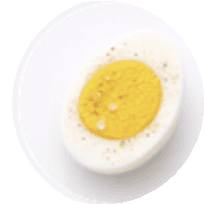
Yolk: Uniform pastel yellow, crumbly yet creamy with no dark ring when properly cooled.
White: Firm, resilient, and easy to chop or slice cleanly.
Follow these steps for more consistent results and easier peeling.
Fill a medium saucepan with enough water to cover your eggs by about 1 inch. Bring to a full boil over high heat.
Use a slotted spoon or spider skimmer to lower cold eggs straight into the boiling water one by one. Never drop eggs in by hand.
Hit 'Start Timer' on CookTiming the moment all eggs are submerged. Set the stove burner to medium-high to maintain a gentle bubble.
Keep the water at a gentle simmer rather than a violent thrashing boil. Violent boiling knocks shells against each other, causing fractures.
When the timer chimes, promptly transfer eggs to a bowl of cold water and ice cubes. Let them cool for about 5 to 10 minutes.
Gently tap the wider bottom end (the air pocket) on the counter, roll lightly between your palms, and peel under a trickle of cool water.
Transferring eggs into ice water (roughly half cold water, half ice cubes) after cooking is one of the most reliable ways to get consistent results, for two key reasons:
Eggs retain significant internal heat after removal from the pot. Without rapid cooling, a soft-boiled egg can continue firming well past the target doneness.
The sudden drop in temperature causes the hot steam between the white and the inner shell membrane to condense, contracting the egg slightly away from the shell.
When lowering standard Large refrigerated eggs into gently boiling water at sea level, approximate boiling times for each yolk consistency are:
*Note: These approximate timings apply to Large eggs (~57g) from a 4°C (39°F) refrigerator lowered into boiling water at sea level. Results may vary with your equipment. Use the timer controls above to adjust for egg size, starting temperature, or elevation.
Cooking an egg is fundamentally about heat transfer — from the boiling water through the shell and white into the yolk center. Several variables affect how quickly this happens:
A Small egg (~45g) has significantly less thermal mass than an Extra Large egg (~64g). Larger eggs require 30 to 45 additional seconds for heat to penetrate to the core.
Eggs straight from the fridge start at around 4°C (39°F), while counter eggs sit around 20°C (68°F). Counter eggs heat up faster, saving about 1 full minute of cook time.
At sea level, water boils at 100°C (212°F). At higher elevations such as Denver (~5,280 ft), it boils at roughly 95°C (203°F). The lower boiling temperature means eggs cook more slowly and need more time.
Dropping 6 cold eggs into a small pot drops the water temperature significantly, delaying heat transfer. Always use a generous volume of water so the boil resumes within 15–20 seconds.
Peeling boiled eggs cleanly can be tricky. These widely recommended techniques may help reduce sticking:
Lowering cold eggs into already-boiling water may help the egg white contract away from the inner shell membrane, which can make peeling easier.
Fresh farm eggs have a lower pH (~7.6) which binds whites tightly to the shell. As eggs age in the fridge (7–10 days), pH rises (~9.2), loosening the membrane.
Gently crack the wider bottom end first to break the air cell. Running cool water can slip under the membrane, helping separate the shell from the egg.
A thrashing rolling boil rattles eggs against the pot sides and bottom, causing hairline fractures that leak white ribbons into the water. Turn heat down to a gentle simmer once eggs are in.
Air cooling is slow. Residual heat can continue cooking the yolk, turning a jammy egg firmer than intended and potentially causing the grey-green ring on hard-boiled eggs. Transfer to ice water promptly for best results.
Do not start the timer while filling the pot or waiting for the initial boil. Start only when the last egg is fully submerged in the boiling water.
Runny Yolks: The USDA recommends cooking eggs until both the yolk and white are firm, which corresponds to an internal temperature of at least 160°F (71°C). Soft-boiled and medium-boiled eggs with runny or jammy yolks do not reach this temperature. Young children, pregnant women, older adults, and immunocompromised individuals should eat fully cooked eggs or use pasteurized shell eggs.
Refrigeration: According to the USDA, cooked eggs should not remain at room temperature for more than 2 hours. Hard-boiled eggs in their shells can be refrigerated for up to one week. Peeled hard-boiled eggs should be stored in a covered container in the refrigerator and consumed within a few days.
Quick reference table based on standard refrigerated eggs lowered into gently boiling water at sea level.
| Doneness Level | Small (~45g) | Medium (~50g) | Large (~57g) | XL (~64g) | Yolk Consistency |
|---|---|---|---|---|---|
| Soft (Liquid Yolk) | 5 min 30 s | 5 min 45 s | 6 min 00 s | 6 min 30 s | Warm runny liquid yolk, very delicate white |
| Medium-Soft (Gooey Yolk) | 6 min 30 s | 6 min 45 s | 7 min 00 s | 7 min 30 s | Warm runny center with setting edges |
| Medium / Jammy (Fudgy) | 8 min 00 s | 8 min 15 s | 8 min 30 s | 9 min 00 s | Creamy, custardy, jam-like yolk throughout |
| Medium-Hard (Semi-Firm) | 9 min 30 s | 9 min 45 s | 10 min 00 s | 10 min 30 s | Firm outer yolk with slightly soft center |
| Hard-Boiled (Creamy Set) | 11 min 00 s | 11 min 15 s | 11 min 30 s | 12 min 00 s | Completely set, crumbly-creamy pale yellow |
Warm runny liquid yolk, very delicate white
Warm runny center with setting edges
Creamy, custardy, jam-like yolk throughout
Firm outer yolk with slightly soft center
Completely set, crumbly-creamy pale yellow
Everything you need to know about boiling times, peeling techniques, and timer features.
For a standard Large refrigerated egg lowered into gently boiling water at sea level: approximately 6 minutes for a soft-boiled egg with a runny yolk, 8½ to 9 minutes for a jammy medium egg, and 11½ to 12 minutes for a firm hard-boiled egg. Adjust by about 30 seconds for Extra Large or Small eggs. Times are approximate and may vary with your equipment.
Precision culinary tools
Time spaghetti to al dente perfection with taste-check alerts & salt ratios.
Time Basmati, Jasmine, and Brown rice with water ratios & steam rest tracking.
Time chicken breasts, thighs, and tenders safely with 165°F temperature check.
Time baby potatoes, russets, and yukon golds for fork tenderness.