Spaghetti transitions swiftly from chalky to firm, tender, and mushy. Compare bite characteristics to match your favorite sauce.

Cross-Section: Firm to the tooth with a microscopic pale dot in the center; flexible yet resistant to crushing.
Chew / Bite: Distinct springy chew; does not stick to teeth or feel mushy.
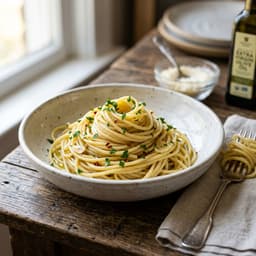
Cross-Section: Uniformly hydrated throughout with no pale white core; soft exterior with gentle structure.
Chew / Bite: Supple and smooth; yields easily without resistance.
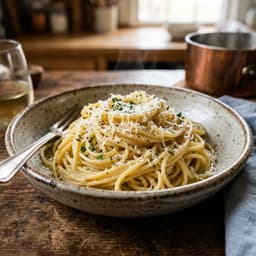
Cross-Section: Extensively hydrated; starch granules are fully gelatinized with zero central resistance.
Chew / Bite: Very soft, effortless to chew, tender throughout.
Follow the classic culinary standard for perfectly separated, well-seasoned strands that marry seamlessly with sauce.
Aim for at least 4 quarts (3.8 liters) of water per 1 pound (450g) of dry spaghetti. Ample water prevents temperature drop when pasta is submerged and prevents starch from turning the water gummy.
Add 1 to 1.5 tablespoons of coarse sea salt or kosher salt per gallon of water. Salt penetrates the pasta strands as the starches hydrate and expand, seasoning the pasta from within.
Hold the pasta bundle vertically, drop it in the center, and fan it outward. As the submerged bottoms soften (within 15–20 seconds), gently press the remaining lengths underwater with tongs or a wooden fork.
The initial 60 seconds are critical: surface starches are sticky before heat gelatinization seals them. Give 2–3 vigorous stirs to ensure no strands adhere to one another or the bottom of the pot.
Pull a strand with tongs, cool for 2 seconds, and bite down. For al dente, look for a microscopic chalky dot in the center with pleasant resistance. If too crunchy, let boil for another 45–60 seconds.
Never rinse cooked spaghetti with cold tap water (which strips surface starches). Transfer pasta directly into your warm sauce pan with a splash of reserved cooking water, tossing vigorously to emulsify a glossy, clinging sauce.
The secret to restaurant-quality spaghetti lies in the golden ratio: 100g Pasta : 1 Liter Water : 7–10g Salt.
When you plunge room-temperature spaghetti into a pot, water temperature immediately plummets. A large volume of boiling water recovers to a rolling boil within 20 seconds, preventing surface starches from turning gummy.
As spaghetti boils, it releases microscopic starch molecules into the salted water. Always ladle out ½ cup of this cloudy water before draining. Tossed into your sauce with butter or olive oil, it binds and creates a glossy restaurant sheen.
The exact cooking time for spaghetti depends primarily on the strand thickness and whether it is dried durum semolina or fresh egg pasta. For dried spaghetti submerged in vigorously boiling salted water:
*Always refer to your specific pasta brand box as a baseline, since semolina density and strand diameters vary across manufacturers (e.g. Barilla, De Cecco, Rummo, Garofalo).
Cooking pasta is a balance of starch gelatinization and protein coagulation. Several kitchen factors influence how rapidly heat and moisture penetrate the pasta core:
Spaghettini (#3, ~1.5mm) cooks in 5–6 minutes, standard Spaghetti (#5, ~1.9mm) in 9–10 minutes, and thick Spaghettoni (#8, ~2.2mm) in 11–12 minutes. Even a 0.3mm difference shifts cooking duration by 2 to 3 minutes.
Artisanal pasta pushed through traditional bronze dies has a chalky, porous, micro-grooved surface that absorbs water slightly faster and binds sauce dramatically better than smooth, Teflon-extruded mass-market pasta.
Top Italian kitchens drain spaghetti 1 to 2 minutes early and transfer it into the sauce skillet with reserved cooking water. The pasta absorbs sauce flavors in its final cooking stage without becoming mushy.
At higher elevations (such as Denver or Mexico City), water boils at 94°C–96°C instead of 100°C. Starch gelatinization occurs slower at lower temperatures, requiring an additional 1 to 2 minutes of cooking time.
Forget kitchen folklore — here are the scientifically verified culinary methods for checking pasta doneness:
Bite a strand in half and examine the cross-section. For true al dente, look for a microscopic, faint white pinhead dot at the exact core. When cooked tender, the cross-section turns completely translucent yellow.
Taste a strand 90 seconds before target time. It should yield smoothly on the outer layer, offering pleasant, firm tactile resistance at the core without tasting chalky or sticking to your molars.
Throwing spaghetti against the wall only tests if external starches have become gelatinous and sticky. In fact, overcooked mushy pasta sticks even better to tiles! Always bite and taste instead.
Oil floats on top of the water and coats the spaghetti strands when you drain them. This oily slick prevents sauce from clinging, causing tomato, pesto, or cream to slide right off onto the plate.
Rinsing washes away the delicate coating of warm surface starches that naturally thicken and emulsify sauce. Only rinse pasta if you are making a chilled pasta salad.
Long spaghetti strands are engineered to twirl neatly onto a fork, carrying sauce along with them. Simply fan out the bundle in boiling water; within 20 seconds, the submerged ends will soften and the full length can be gently eased in.
Starchy pasta water is the secret ingredient of Italian cuisine. Always reserve ½ to 1 cup before dumping the pot. A small ladleful creates silkiness and eliminates dry, separated sauces.
Starch granules expand and become tackiest during the first minute of boiling. If not stirred thoroughly upon entry, strands will weld together into dense clumps.
The 2-Hour Rule (*Bacillus cereus* Awareness): Cooked pasta contains water and starch, creating an ideal environment for spore-forming bacteria such as Bacillus cereus. Never let cooked pasta sit at room temperature for more than 2 hours. Cool leftovers quickly and transfer them into shallow airtight containers in the refrigerator.
Refrigeration & Shelf Life: Cooked spaghetti safely lasts 3 to 5 days in a refrigerator held below 40°F (4°C). For best reheating texture, toss leftovers in a wide skillet over medium heat with 2 tablespoons of water, stock, or sauce rather than microwaving uncovered.
Authoritative timing and taste-check reference for dried, fresh, thin, and thick spaghetti varieties.
| Spaghetti Variety | Strand Diameter | Package Standard | Al Dente Target | Taste Check At | Culinary Profile & Sauce Match |
|---|---|---|---|---|---|
| Standard Spaghetti (#5) | 1.8 – 2.0 mm | 9 to 11 min | 8 to 10 min | Minute 8 | Sturdy, balanced chew; universal match for tomato, meat, and emulsion sauces. |
| Spaghettini / Thin (#3) | 1.4 – 1.6 mm | 5 to 7 min | 5 to 6 min | Minute 4:30 | Delicate and light; pairs best with extra virgin olive oil, garlic, and fresh clams. |
| Spaghettoni / Thick (#8) | 2.1 – 2.4 mm | 11 to 13 min | 10 to 12 min | Minute 10 | Dense, muscular bite; holds up against rich guanciale, cream, and wild game ragùs. |
| Capellini / Angel Hair (#1) | 0.8 – 1.1 mm | 3 to 4 min | 2½ to 3 min | Minute 2 | Ultra-fine; overcooks in seconds. Use gentle broth, melted butter, or light herb oil. |
| Whole Wheat Spaghetti | 1.8 – 2.0 mm | 8 to 10 min | 7 to 9 min | Minute 7 | Nutty, high-fiber bran texture; benefits from firm al dente to avoid grainy softness. |
| Fresh Egg Spaghetti | 2.0 – 2.2 mm | 2 to 4 min | 2 to 3 min | Minute 1:45 | Silky, tender protein network; floats when partially cooked, finishes rapidly. |
Sturdy, balanced chew; universal match for tomato, meat, and emulsion sauces.
Delicate and light; pairs best with extra virgin olive oil, garlic, and fresh clams.
Dense, muscular bite; holds up against rich guanciale, cream, and wild game ragùs.
Ultra-fine; overcooks in seconds. Use gentle broth, melted butter, or light herb oil.
Nutty, high-fiber bran texture; benefits from firm al dente to avoid grainy softness.
Silky, tender protein network; floats when partially cooked, finishes rapidly.
Everything you need to know about package baseline timings, al dente testing, salt ratios, and sauce pairing.
Start the timer the moment all spaghetti strands are completely submerged into vigorously boiling salted water. Give the pot a thorough stir immediately upon dropping the pasta to separate the strands while surface starches begin gelatinizing.
Precision culinary tools
Time soft, medium & hard-boiled eggs with custom sizes & altitude compensation.
Time Basmati, Jasmine, and Brown rice with water ratios & steam rest tracking.
Time chicken breasts, thighs, and tenders safely with 165°F temperature check.
Time baby potatoes, russets, and yukon golds for fork tenderness.