Doneness is defined by internal core temperature and protein coagulation, not merely surface color. Compare textures, colors, and culinary benchmarks below.
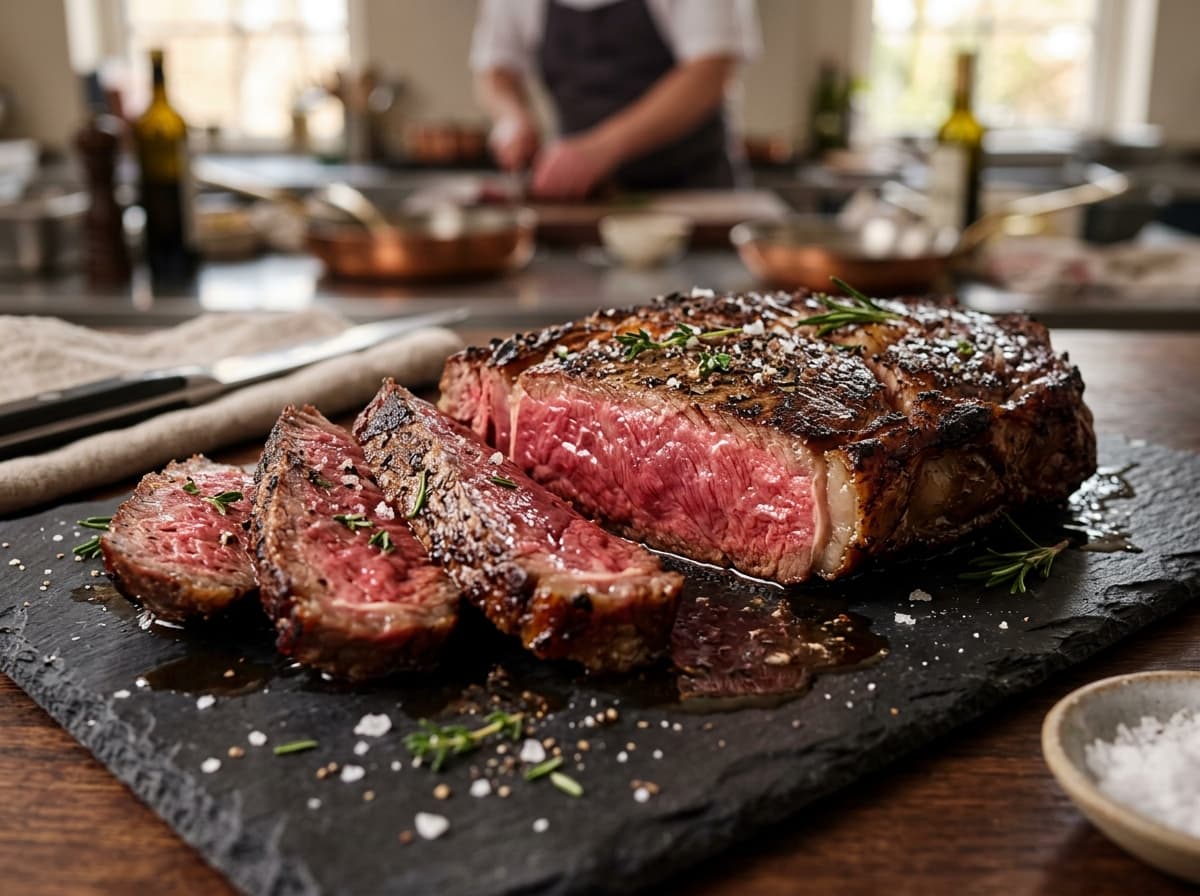
Cool to warm vibrant red center
Seared on the outside, red and cool-to-lukewarm in the center. Extremely tender for lean cuts like filet mignon.
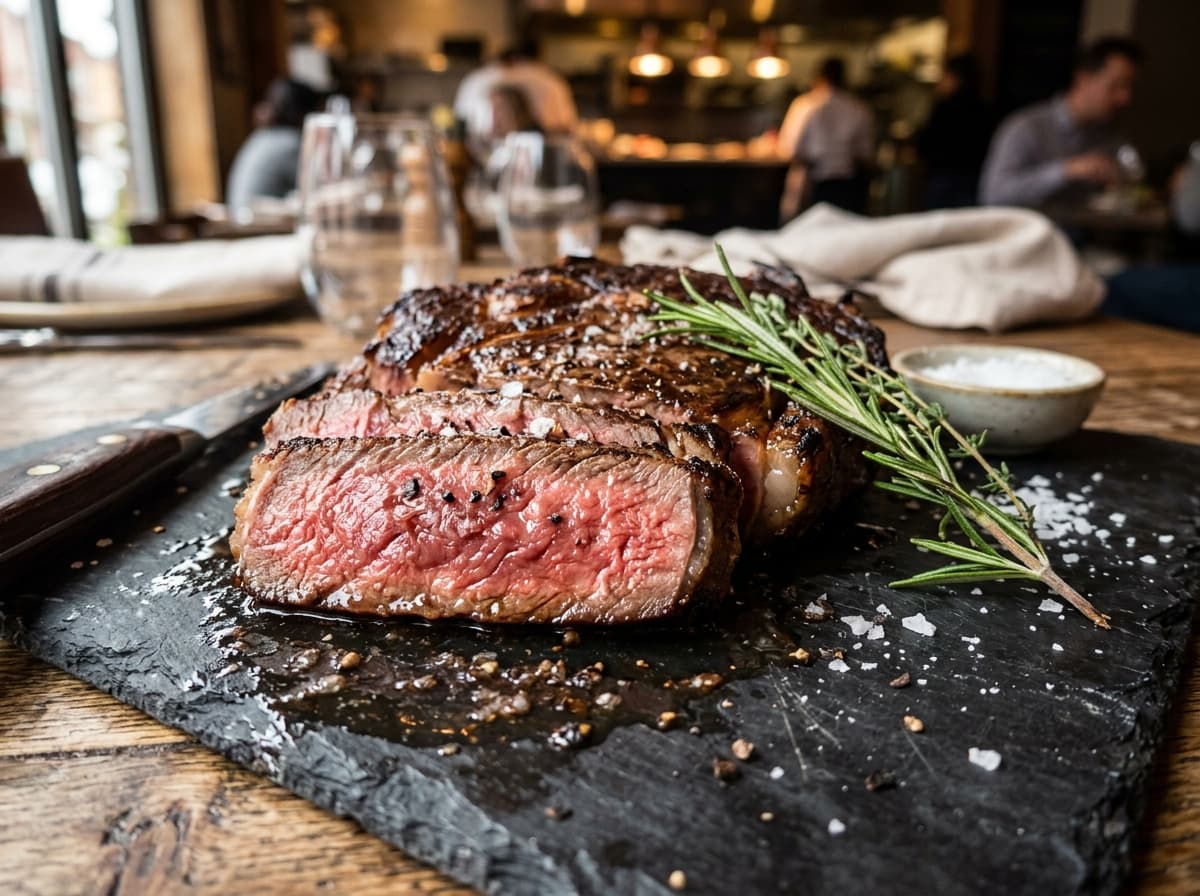
Warm red center fading to pink ring
The culinary gold standard. Warm red center, glistening juices, and enough heat to render intramuscular marbling without drying.
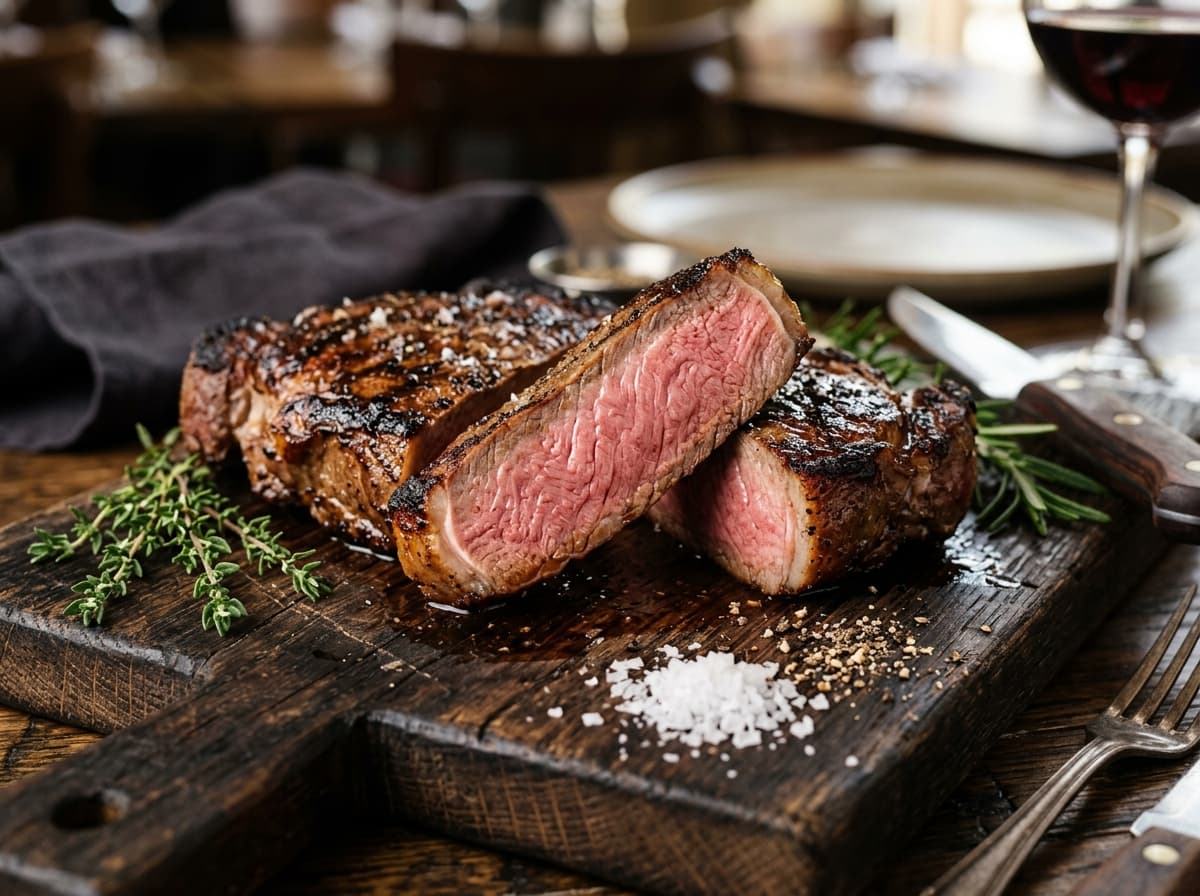
Warm pink center throughout
Even warm pink center with no raw red meat remaining. Satisfying firm bite and fully rendered fat cap.
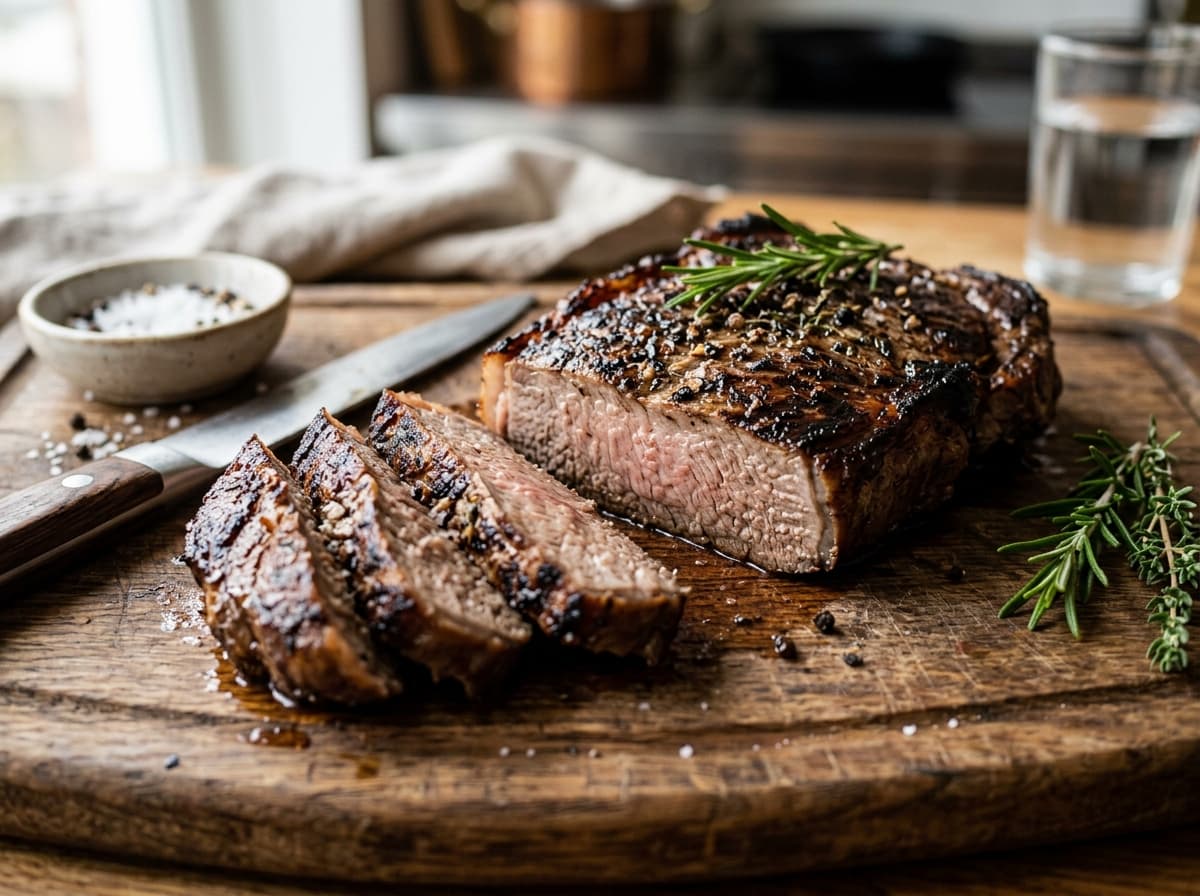
Faint trace of pale pink in deepest core
Mostly grayish-brown throughout with only a subtle whisper of pink in the center. Firm texture with deeply caramelized exterior.
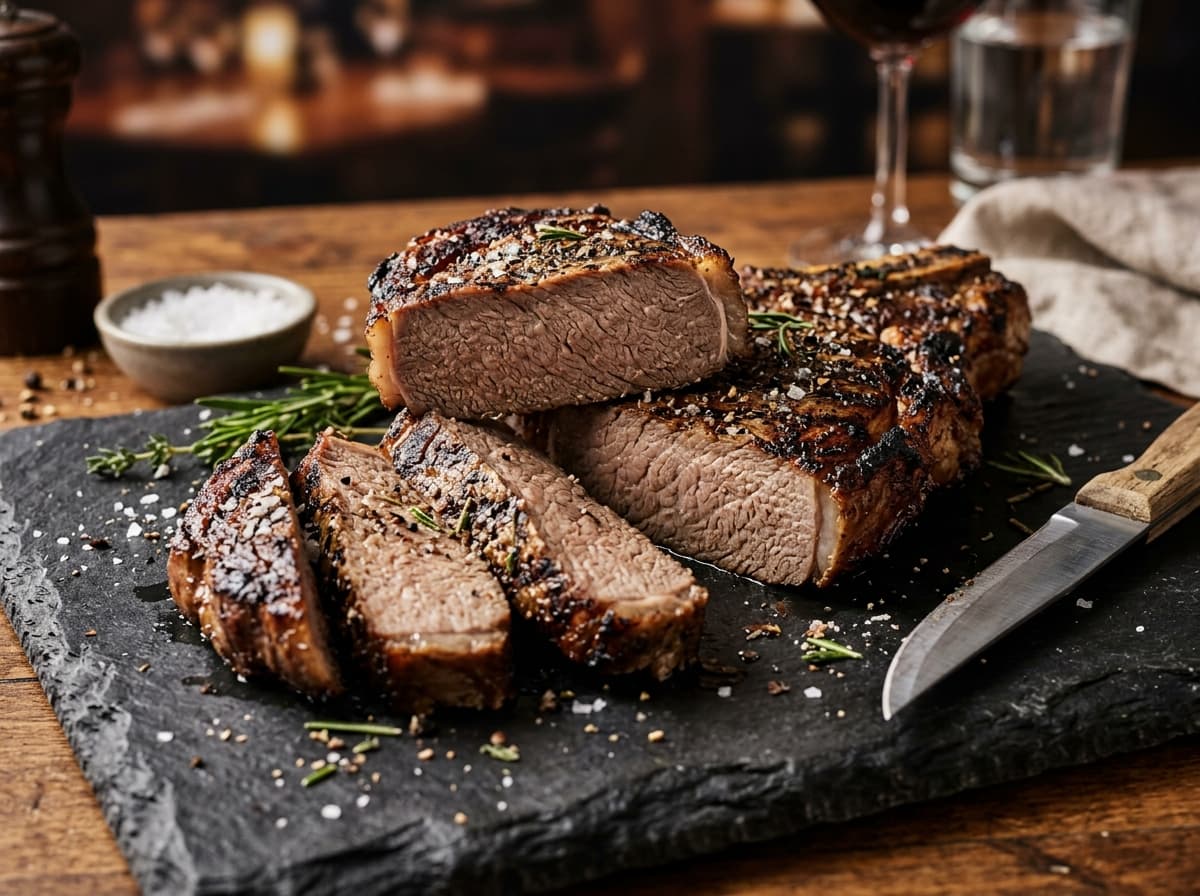
Uniform solid grayish-brown throughout
Thoroughly cooked through with zero pink meat. Heavy surface caramelization and completely coagulated beef proteins (160°F+ / 71°C+).
From cold pan prep to the final rest, follow this evidence-based workflow to achieve a dark, savory crust with a juicy, edge-to-edge pink interior.
Moisture is the enemy of a golden Maillard crust. Pat every side of the steak vigorously with clean paper towels until completely dry.
Season with coarse kosher salt and freshly cracked black pepper. Season either 45 minutes prior (dry-brining) or immediately before placing in the pan.
Use a cast-iron skillet or heavy stainless pan. Heat over medium-high until a high-smoke-point oil (avocado or grapeseed) shimmers and begins to smoke lightly.
Gently lay the steak down away from you to prevent hot oil splatters. You should hear an intense, loud sizzle. Press 'Start Steak Timer'.
Flip the steak when CookTiming alerts you at the halfway mark. Searing the second side builds uniform thermal penetration without burning.
In the final 1–2 minutes, add 2 tablespoons of unsalted butter, crushed garlic cloves, and fresh thyme or rosemary. Spoon foaming butter over the crust.
Insert thermometer horizontally into the center of the thickest point. Pull steak when core reads 3°F–5°F below your final target (e.g. pull at 130°F for 135°F medium-rare).
Transfer to a warm carving board. Rest for 5–8 minutes so muscle fibers relax and savory juices redistribute. Slice against the grain on a 45° angle.
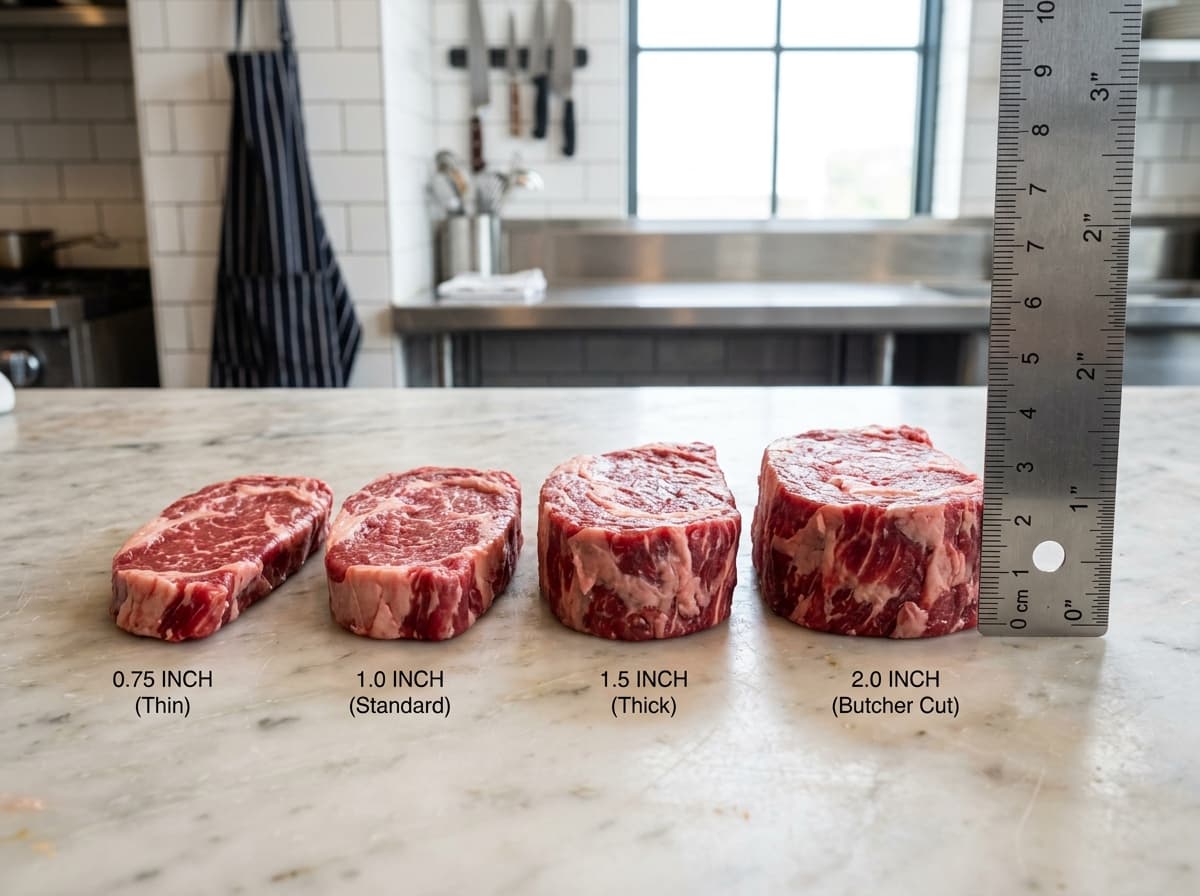
In culinary thermodynamics, heat does not travel into meat at a constant speed. Meat tissue is largely composed of water, protein, and fat—all relatively poor thermal conductors. As a result, doubling steak thickness quadruples the time required for heat to diffuse into the deepest geometric core.
Thin Steaks (< 0.75" / 19mm): Because the core is so close to the searing pan surface, heat reaches the center before a deep, caramelized crust can develop. Thin steaks require screaming-hot pan temperatures and short, fast cooking (2–3 minutes per side) to avoid drying out the interior.
Standard Steaks (1.0" to 1.25" / 25–32mm): The ideal steakhouse sweet spot. There is enough mass for an intense, deep brown crust while keeping the interior juicy, warm, and medium-rare.
Thick Butcher Cuts (1.5" to 2.0"+ / 38–51mm): If seared continuously in a hot skillet, the exterior will blacken and burn before the center reaches 130°F. These cuts require two-stage cooking: either searing then finishing in a moderate 350°F oven, or our recommended Reverse Sear (gentle 225°F oven roasting followed by a 1-minute flash sear).
Calibrated values across thickness, doneness, and cooking method. Both pan and grill times factor in a halfway flip and 5-minute carryover rest.
| Thickness | Doneness | Skillet / Pan | Outdoor Grill | Pull Temp | Final Temp | Visual Indicator |
|---|---|---|---|---|---|---|
| 0.75" (19mm) | Rare | 5–7 min | 5–7 min | 120°F (49°C) | 125°F (52°C) | Cool red center, soft texture |
| 0.75" (19mm) | Medium Rare | 6–8 min | 6–8 min | 130°F (54°C) | 135°F (57°C) | Warm red center fading to pink |
| 0.75" (19mm) | Medium | 7–9 min | 7–9 min | 140°F (60°C) | 145°F (63°C) | Warm pink center, springy firm |
| 0.75" (19mm) | Well Done | 10–13 min | 10–13 min | 155°F (68°C) | 160°F (71°C) | Uniform brown throughout, solid chew |
| 1.0" (25mm) | Rare | 6–8 min | 6–8 min | 120°F (49°C) | 125°F (52°C) | Deep red interior, tender |
| 1.0" (25mm) | Medium Rare | 8–10 min | 8–10 min | 130°F (54°C) | 135°F (57°C) | Warm red center, juicy marbling |
| 1.0" (25mm) | Medium | 9–11 min | 9–11 min | 140°F (60°C) | 145°F (63°C) | Warm pink center, USDA 145°F standard |
| 1.0" (25mm) | Well Done | 13–16 min | 13–16 min | 155°F (68°C) | 160°F (71°C) | No pink, fully set protein |
| 1.5" (38mm) | Rare | 9–12 min | 10–13 min | 118°F (48°C) | 125°F (52°C) | Vibrant cool red center, thick crust |
| 1.5" (38mm) | Medium Rare | 11–14 min | 12–15 min | 128°F (53°C) | 135°F (57°C) | Warm red center fading to pink ring |
| 1.5" (38mm) | Medium | 13–16 min | 14–17 min | 138°F (59°C) | 145°F (63°C) | Warm pink center, juicy |
| 1.5" (38mm) | Well Done | 18–22 min | 19–23 min | 155°F (68°C) | 160°F (71°C) | Uniform brown, finish in 350°F oven |
| 2.0" (51mm) | Medium Rare (Reverse Sear) | 25–35m oven + 2m sear | 25–35m oven + 2m sear | 125°F (52°C) | 135°F (57°C) | Edge-to-edge pink, zero gray ring |
| 2.0" (51mm) | Medium (Reverse Sear) | 30–40m oven + 2m sear | 30–40m oven + 2m sear | 135°F (57°C) | 145°F (63°C) | Consistent warm pink, fully rendered fat |
Why can two steaks cook at completely different speeds on the same stove? Understand the 6 real-world variables that determine your steak's journey to doneness.
The single most impactful variable. Heat diffusion time scales exponentially with thickness. A 2-inch steak takes three to four times longer than a 3/4-inch steak.
Heavy cast-iron skillets deliver intense conductive heat that builds a dense Maillard crust quickly. Outdoor grills use open radiant heat, which cooks meat surfaces differently.
Meat straight from a 38°F (3°C) refrigerator requires more thermal energy to warm the core than meat that has had a brief 20-minute counter chill break.
Highly marbled ribeye steaks contain dense fat veins that melt and conduct heat differently than ultra-lean cuts like Filet Mignon, which dry out if cooked past medium-rare.
Bone is a dense insulator. Meat immediately touching the T-bone or rib bone stays cooler and takes 1–2 minutes longer to reach target doneness than outer meat.
Steaks do not stop cooking when removed from the heat. Internal temperature will continue to rise 3°F to 8°F during a 5-minute rest as heat from the outer crust moves inward.
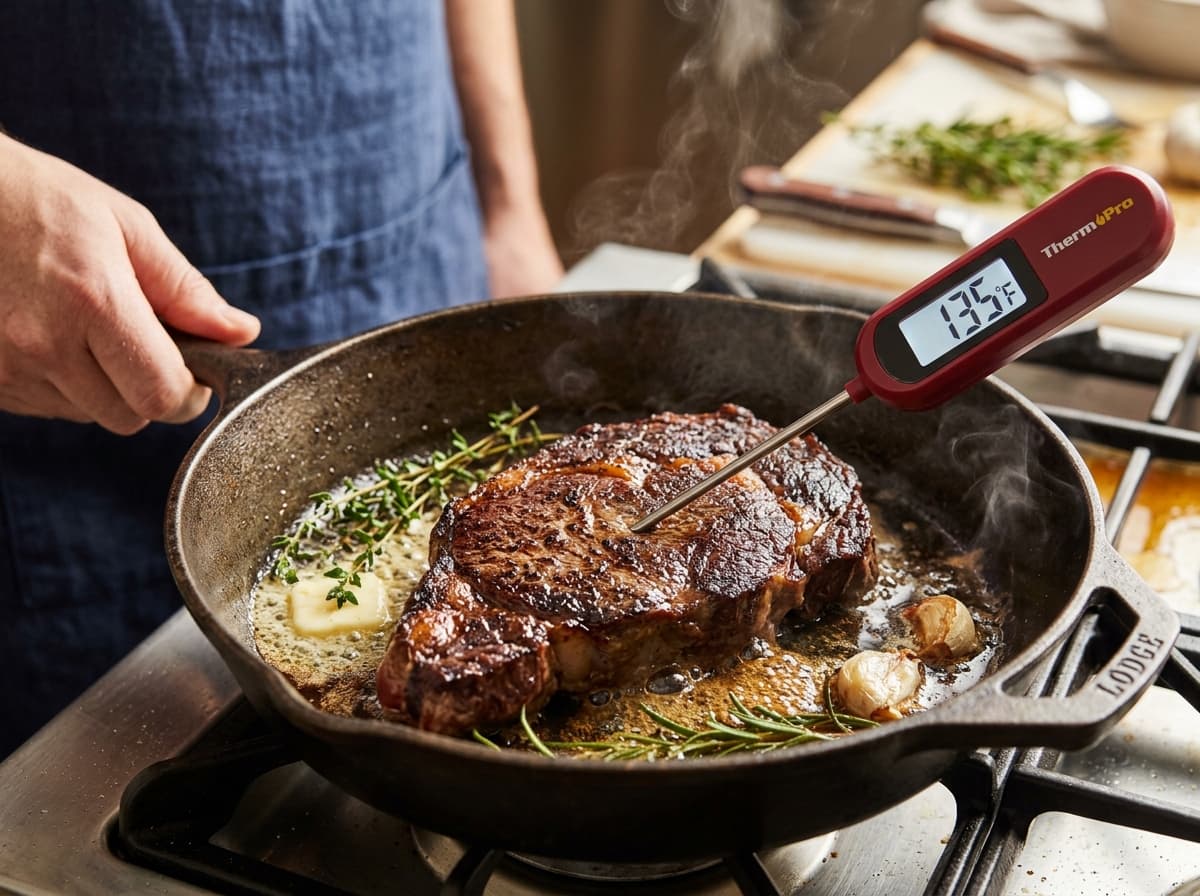
A timer is your guide, but an instant-read digital meat thermometer is your only definitive guarantee of doneness and safety. Follow these four rules for a flawless reading:
Avoid these four frequent kitchen mistakes to elevate your home-cooked steaks to 5-star steakhouse quality.
Why it fails: Surface water boils at 212°F, trapping the meat in steam. The Maillard browning reaction cannot occur until all water evaporates.
The CookTiming fix: Pat all sides of the steak completely dry with paper towels right before cooking.
Why it fails: Hot pressurized juices burst out of tense muscle fibers, leaving a pool of liquid on your board and dry meat.
The CookTiming fix: Rest for 5 minutes (or 8 minutes for thick cuts) so fibers relax and reabsorb moisture.
Why it fails: The finger poke test is subjective and varies wildly based on cut marbling, thickness, and meat age.
The CookTiming fix: Use an instant-read digital probe inserted horizontally into the center for infallible accuracy.
Why it fails: Dramatically drops skillet temperature, causing meat to simmer in its own juices rather than sear.
The CookTiming fix: Cook one large steak at a time, or use two separate skillets heated on high burners.
Something didn't go as planned? Identify the symptom, diagnose the thermal cause, and apply the kitchen solution.
Root Cause: Skillet heat was too extreme for the steak thickness, or meat was placed in pan straight from the deep freezer.
Correction: For steaks 1.5"+ thick, lower heat slightly after the initial crust forms, finish in a 350°F oven, or use our Reverse Sear mode.
Root Cause: Steak was left on the heat until reaching final target temp without factoring in carryover resting rise, or heat was too low causing a large gray band.
Correction: Pull steak 3°F to 5°F below target. Flip more frequently (every 1–2 minutes) to minimize gray banding.
Root Cause: Skillet was not hot enough when meat was dropped in, or meat was wet.
Correction: Preheat cast iron until high-smoke oil shimmers and smokes lightly. Ensure meat is dry.
Root Cause: Steak was unevenly thick, warped during cooking, or bone prevented flat contact with pan.
Correction: Press down gently with a spatula during the first 30 seconds of searing, or use a steak weight.
Understanding the microbiological science between culinary doneness preferences and government safety recommendations.
The United States Department of Agriculture (USDA FSIS) recommends that all whole-muscle beef steaks and roasts reach a minimum internal temperature of 145°F (62.8°C) followed by a mandatory 3-minute rest. At 145°F, steak corresponds to a solid Medium doneness.
Intact Muscle vs Ground Beef: Unlike ground beef (where surface bacteria can be mixed throughout the interior), bacterial contamination on intact beef steaks resides virtually entirely on the exterior surface. Searing surfaces at 300°F–450°F destroys surface pathogens, which is why chefs widely cook steaks to Rare (125°F) or Medium-Rare (135°F). However, high-risk individuals (elderly, pregnant, immunocompromised) should always observe the 145°F guideline.
2-Hour Rule: Never leave cooked or raw steak at room temperature for more than 2 hours (or 1 hour if the ambient temperature is 90°F / 32°C or higher).
Refrigeration: Store leftover cooked steak in airtight containers at 40°F (4°C) or colder for up to 3 to 4 days.
Freezer Storage: Wrap tightly in plastic wrap and aluminum foil or vacuum seal. Keeps safely for 2 to 3 months for optimal texture and flavor.
Do Not Wash Raw Steak: Never rinse raw beef under tap water. Washing splashes contaminated droplets across countertops and sink faucets up to 3 feet away.
Microwaving leftover steak turns expensive beef into gray rubber. For best results, place chilled steak on a wire rack inside a 250°F (120°C) oven for 20–25 minutes until the internal temperature reaches 110°F. If desired, flash-sear in a hot skillet with foaming butter for 30 seconds per side to restore a crisp crust while preserving a pink interior!
Cooking time depends primarily on thickness, desired doneness, and cooking surface. For a standard 1-inch (25mm) steak cooked in a hot cast-iron skillet, expect approximately 8 to 10 minutes total (4–5 minutes per side) for Medium-Rare (135°F / 57°C). Use our interactive calculator above to get a precision estimate for your exact cut and thickness.
Heat diffusion into meat is non-linear. Doubling the thickness of a steak approximately quadruples the time required for heat to conduct into the core. A thin 0.75-inch steak cooks to medium-rare in about 6 minutes, whereas a thick 1.5-inch steak takes 11 to 14 minutes in a skillet or 25–35 minutes using the Reverse Sear method.
Medium-rare has a target core temperature of 130°F to 135°F (54°C to 57°C). Because meat experiences carryover cooking while resting, you should pull the steak off the heat when your digital probe registers 125°F to 128°F (52°C to 53°C).
Medium steak has a target resting core temperature of 140°F to 145°F (60°C to 63°C), with a warm pink center throughout. Pull from the heat at 135°F to 138°F (57°C to 59°C). This temperature satisfies the official USDA FSIS 145°F minimum internal safety guideline after resting.
CookTiming's calculator automatically computes a halfway flip milestone (e.g. at 4 minutes 15 seconds for an 8.5-minute cook). While flipping once is traditional, scientific experiments by culinary scientists confirm that flipping every 60–90 seconds creates an even more uniform edge-to-edge pink interior with a shorter total cook time.
Yes, absolutely. A timer is a reliable cooking guide, but thickness variations, pan heat fluctuation, and ambient temperature mean an instant-read digital probe is the only definitive way to confirm doneness. Always insert the thermometer horizontally from the side into the deepest geometric center.
Yes. Simply select the 'Outdoor Grill' cooking method. Our calculation engine calibrates the radiant heat of direct high-temperature grates (450°F–500°F) and schedules your halfway flip and core thermometer probe check.
Yes, cast-iron pan searing is our default cooking method. Cast iron provides immense thermal mass that maintains intense surface heat when cold meat hits the skillet, creating an exceptional Maillard crust.
Reverse searing is the gold standard for thick-cut steaks (1.5" to 2.5"). The steak is first gently baked in a low 225°F–250°F (107°C–120°C) oven on a wire rack until internal core temperature reaches ~115°F–120°F. Then, it is transferred to a smoking-hot skillet for 60 seconds per side. This yields edge-to-edge pink doneness with virtually zero overcooked gray banding.
Standard steaks can be cooked straight from the refrigerator. While leaving steak on the kitchen counter for 20–30 minutes takes the chill off the surface and helps paper towels dry the exterior for a better sear, never leave raw meat at room temperature for more than 2 hours per USDA food safety standards.
During cooking, high thermal energy causes muscle proteins to tighten, forcing liquid toward the cooler center under pressure. Resting for 5 to 8 minutes allows muscle fibers to relax and reabsorb savory juices. Slicing immediately will spill all the flavorful juices onto your cutting board.
This happens when the surface heat was too extreme relative to the thickness of the steak, or the steak was cooked straight from the deep freezer. For steaks 1.5 inches or thicker, lower the heat slightly after the initial crust forms, finish in a 350°F oven, or use Reverse Sear.
Yes, slightly. Bone is a thermal insulator. The meat directly adjacent to the T-bone or rib bone takes 1 to 2 minutes longer to reach target doneness than outer meat. Always check temperature with your probe tip at least 1/2 inch away from the bone.
Use an oil with a high smoke point, such as avocado oil (smoke point ~500°F / 260°C), refined grapeseed oil (420°F), or ghee / clarified butter. Do not use extra virgin olive oil or whole unclarified butter for the initial sear, as their milk solids and low smoke points will burn and create a bitter flavor.
Yes. You can use the quick adjustment buttons (+30s, -30s, +1m, -1m) to tweak your countdown on the fly, or pause and resume whenever you need to baste or inspect your crust.
Yes. CookTiming uses elapsed hardware timestamps (`Date.now()`) rather than drift-prone browser intervals. When you switch tabs or your device screen dims, the countdown recalculates elapsed time accurately upon your return.
Precision culinary tools
Time soft, medium & hard-boiled eggs with custom sizes & altitude compensation.
Time spaghetti to al dente perfection with taste-check alerts & salt ratios.
Time Basmati, Jasmine, and Brown rice with water ratios & steam rest tracking.
Time chicken breasts, thighs, and tenders safely with 165°F temperature check.